Why a Room Can Feel Different as the Day Turns
See how daylight changes colour, texture and proportion, then choose a spot where a favourite object feels at home throughout the day.
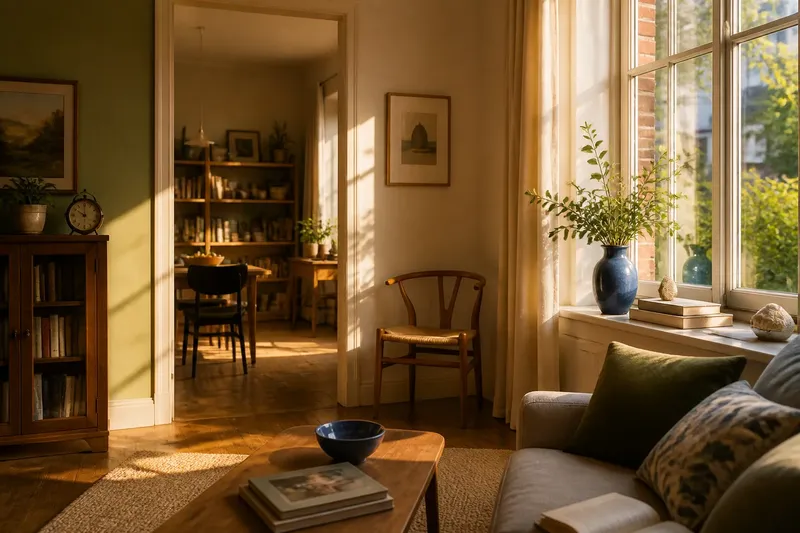
A blue armchair can look soft and grey at breakfast, then vivid by mid-afternoon. If you are wondering why a room feels different as the day turns, changing natural light is a good place to look: it shifts the colours, shadows and apparent scale you see, even when nothing has moved.
That is why it helps to observe a room at several times before deciding where to place a favourite object. A ceramic vase, framed print or old wooden clock may seem just right in one patch of light and oddly lost in another.
Why does the same room look different through the day?
Daylight changes direction, strength and colour as the sun moves, and the room receives it differently through each window. A north-facing room may have steadier, cooler light, while a room with a west-facing window can grow warmer and more dramatic later in the day. Nearby buildings, trees, curtains and the weather all shape what reaches the walls.
Light also bounces. A pale wall can send a soft glow across a ceiling; a deep green sofa may cast a faint tint onto a nearby surface. In a room with a large window, moving shadows from a tree or balcony railing can become part of the interior’s daily rhythm.
Try looking from the doorway as well as from your usual seat. A change in viewpoint can reveal that the room’s apparent mood comes from one bright window or a particular shadow, rather than from the furniture or paint alone.
How does daylight change the colours I see?
Colours are not fixed appearances. Warm sunlight can bring out yellow, rust or pink undertones, while cool or cloudy daylight may make the same shades feel quieter, bluer or more muted. A white wall can look creamy near a sunlit window and grey in a shaded corner.
Glossy surfaces reflect bright patches and can look more intense where light lands directly. Matte paint and unpolished wood tend to show gentler shifts, though their colour still changes with the light. This is why a cushion, rug or paint sample that looks balanced in a shop may feel different at home.
If you are considering a colour change, hold a sample against the wall where it will be used and look at it across the day. Keep nearby finishes in view: a honey-coloured floor or a green garden outside can influence how the sample reads.
Can daylight make a room feel larger or smaller?
It can change the impression of space without changing the room itself. A sunlit wall may seem to recede, while a dim corner can feel enclosed; sharp shadows can make a simple alcove look deeper. Brightness is only part of the effect, since contrast between the window, walls and furnishings also draws the eye.
A tall bookcase beside a bright window may appear more imposing than the same bookcase against an evenly lit wall. Likewise, a low table can almost disappear in a shadowed area and become a stronger presence when sunlight catches its top.
Before rearranging furniture to correct a room’s proportions, notice whether the effect changes with the hour. If it does, the light may be shaping your impression more than the layout is.
Where should I place a favourite object?
Choose a place that suits both the object and the light it will meet through the day. A glazed bowl may catch a bright patch beautifully, while a small carved figure may be easier to appreciate against a calmer background without strong glare.
Imagine you have a handmade blue vase that looks striking on a sunny windowsill but fades against the same view on a cloudy morning. You could move it to a shelf beside the window, where it receives softer side light; the expected result is that its outline remains easier to see as the daylight shifts.
Give the object a little breathing room and look at it from the places where you spend time. The best spot may be the one visible from your favourite chair, not the one that looks most composed from the doorway.
How can I observe the light before deciding?
Spend a few ordinary moments in the room at different points in the day. You need not keep a formal record; a brief look during breakfast, after lunch and in the early evening can reveal whether the room has a steady glow, a moving bright patch or a corner that stays in shade.
For a more deliberate comparison, note what changes:
- Window light: Notice which wall receives direct sun and when it moves.
- Colour: Look at a wall, cushion or rug in both bright and shaded areas.
- Surface: Check whether glass, polished wood or a metallic finish creates glare.
- Shadows: Watch for shapes cast by plants, blinds or nearby buildings.
- Viewpoint: Compare the room from the doorway and from your usual seat.
- Object: Set your chosen piece in a possible spot and see whether its details remain visible.
A quick note on your phone can help if you keep forgetting what the room looked like earlier. Jot down the time and one visible change, such as “warm light on the rug” or “picture frame reflecting the window”.
What should I consider before putting something in direct sun?
Direct sunlight can create strong reflections and can gradually affect some materials, including paper, photographs, textiles and certain finishes. If an object has sentimental or practical value, a position out of the brightest beam may be preferable, even if a sunny display looks appealing for part of the day.
Think about how you use the room, too. A bright reflection on a television or a shiny tabletop may be distracting from the sofa, while a patch of sun on a reading chair can feel pleasant at one time and uncomfortable at another. Curtains or a change of angle may soften the effect without making the room feel closed off.
For a treasured item, check any care advice that came with it before settling on a position. You can also rotate a display now and then if you would like the room to feel fresh without making a permanent change.
Which room-light questions do people ask most?
Why does white paint look yellow in one corner?
That corner may receive warmer reflected light from wood, brick or nearby furnishings, while another area gets cooler daylight. View the wall beside its trim and floor at different times before deciding whether the paint itself is the problem.
Should I place art where the sun hits it?
It depends on the artwork and how the glare affects your view. A framed piece may look lively in angled light, but a strong reflection can obscure it, and delicate materials may need a less exposed position.
Why does a room look flatter on a cloudy day?
Cloud cover softens shadows and reduces the contrast that gives surfaces a sense of depth. Textures and colour distinctions can seem subtler, even though the room and its furnishings have not changed.
Is morning or evening light better for displaying an object?
Neither is best for every object or room. Morning light may be cooler and more direct in one space, while evening light may bring warmth elsewhere, so choose according to when you want to enjoy the piece and how it appears at other times.
How can I use these changes without overthinking them?
Let the room’s daily shifts guide small, reversible decisions. Move a vase, turn a chair slightly or try a framed print on another wall, then notice whether the change feels good during the hours you are actually at home.
The useful question is not whether a room looks identical all day, but whether its changing light supports the way you live in it. Watch the colour and shadows for a few days, and place your favourite object where it feels considered in more than one moment.