The Myth That Every Room Needs a Single Focal Point
A room does not need one dominant feature. Learn how to arrange several modest points of interest so the space feels coherent, not competitive.
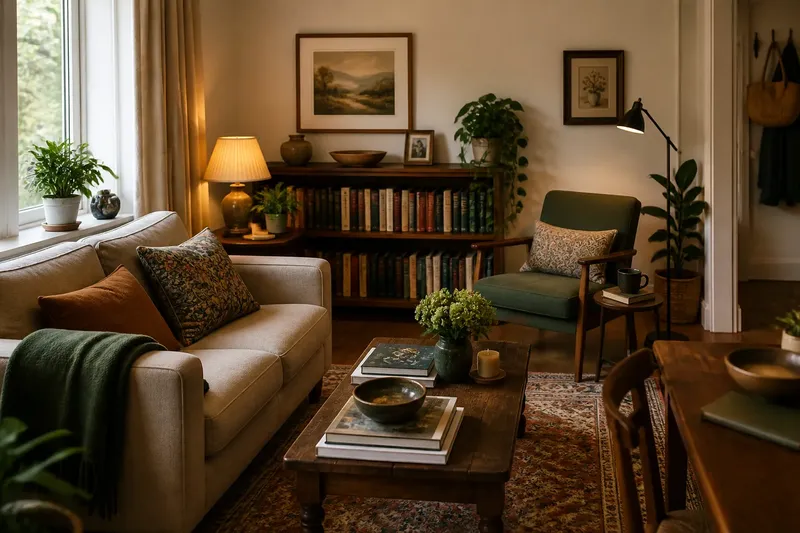
You can sit on the sofa, look across the room and notice the bookcase, a framed print and the lamp beside an armchair without any one of them taking over. A room with several points of interest can feel settled and personal; it simply needs a clear way for the eye to move between them. The idea that every room needs a single focal point is a decorating convention, not a rule.
The useful question is not “Which feature must dominate?” but “What should this room let me notice, and in what order?” Your answer depends on the room’s shape, its everyday purpose and the things you want to keep visible. This guide sorts those situations so you can decide whether to create a lead feature, share attention or leave some parts quiet.
When does one focal point still make sense?
A single focal point can help when a room feels directionless or has one natural feature that already gathers attention. A fireplace, a large window with a view or a substantial piece of art may give the eye an easy place to land. Supporting details can then make that feature feel considered rather than lonely.
This approach is especially useful in a room with a simple layout and a clear seating arrangement. If the chairs face a fireplace, for instance, it may be pleasant for the fireplace to lead, while a low table, a reading lamp and a few books offer smaller things to discover. The secondary pieces do not need to match; they need to belong to the same lived-in scene.
It also suits people who prefer visual quiet. A lead feature gives you a straightforward editing test: if another object keeps drawing attention away from it, ask whether that object has a better home or needs less prominence. You are not obliged to remove every rival; just decide what deserves the first glance.
Keep one feature in front when the room has an obvious anchor and your furniture naturally faces it.
When should several features share attention?
Shared attention often fits a room that serves more than one purpose, or one with no strong architectural feature. In a living room used for reading, conversation and hobbies, it can feel artificial to make a television or one oversized picture the sole centre. A small group of distinct features lets different parts of the room matter at different moments.
Think of the points of interest as a loose sequence rather than a row of competitors. A colourful print might catch your eye from the doorway; a table lamp and chair could invite you towards a reading corner; a ceramic bowl or a stack of well-used books might reward a closer look. Each has a different role and scale, so they do not all need to shout.
Shared attention is also a good fit when you have personal objects you want to live with, rather than store away because they do not belong to a prescribed scheme. A framed family photograph, a small collection of pottery and a leafy plant can sit comfortably together if each has enough space to be seen. They do not need a matching set or a single theme announced in large letters.
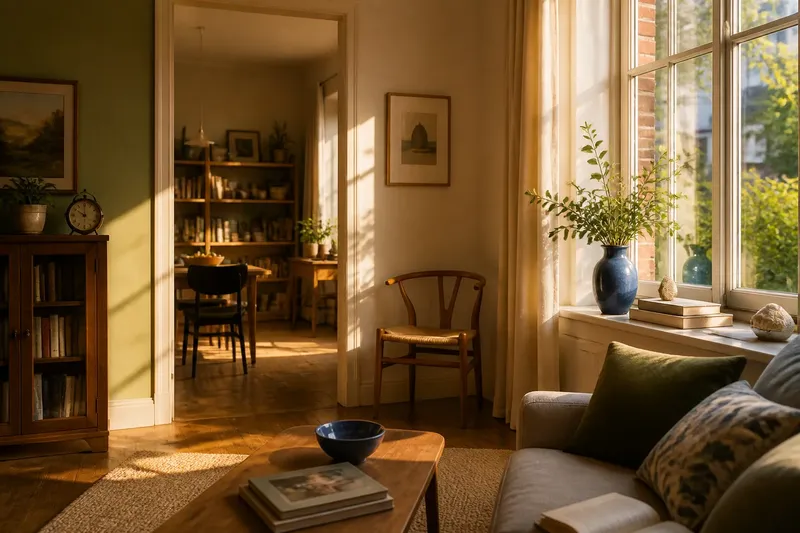
Imagine a narrow sitting room with a modest sofa, a low shelf of favourite books and a small framed landscape. If you place a warm-shaded lamp beside the sofa and keep the shelf display selective, the eye can move from print to books to reading seat without any object having to dominate. The expected result is a room that feels connected while still giving each element its own presence.
How do you choose the right arrangement for your situation?
Start with what the room is doing, not with a decorative rule. Use the situation that sounds closest to yours, then adjust the arrangement as you live with it.
- A room with a natural architectural anchor: Let the fireplace, window or built-in shelving lead if it already shapes where people sit or look. Keep nearby furnishings supportive, and avoid adding a competing oversized feature unless the room still feels unbalanced.
- A room with several everyday activities: Give each activity a modest visual cue. A reading chair can have a lamp and a book within reach; a board-game table might hold a shallow tray for pieces; conversation seating can face one another rather than all turning towards a screen.
- A room with cherished objects: Choose a few pieces with different forms or heights, then leave breathing room around them. A collection does not have to be displayed all at once; rotate what is out so the objects you see remain legible rather than blending into a crowded backdrop.
- A room that feels busy before you add anything: Look at what already draws the eye, including patterned flooring, open storage or strong wall colour. Keep new additions quieter, or group small items so they read as one composed area instead of many separate interruptions.
- A room that feels blank or hard to settle into: Add one or two points of interest near places where people pause, such as a chair, a doorway or a dining table. A lamp, textile, framed picture or plant can give the eye something to meet without requiring a dramatic centrepiece.
- A room with no clear direction from the entrance: Decide what you would like visitors to notice first, then place that feature where it can be seen from the doorway. Let other details unfold further into the room rather than lining them all up in the first view.
These choices are not fixed categories. A room can have a leading feature and still share attention elsewhere; the point is to choose deliberately instead of adding objects until something happens to dominate.
What helps several points of interest feel connected?
Give the eye a route. A useful route might begin with a framed picture, continue to a nearby plant and finish at a reading chair. You can create that connection through placement, repeated colour, related materials or the way furniture faces; you do not need every object to match.
Vary scale and visual weight. Several large, high-contrast items placed at the same height can compete, while a mix of a substantial chair, a small side table and a lighter print gives each a different presence. Height matters too: a picture above a low cabinet, a table lamp and a floor plant create a gentle change in level.
Pay attention to negative space. A clear patch of wall or an uncluttered stretch of tabletop gives nearby objects room to register. If every surface is filled, even treasured pieces can lose their character because the eye has nowhere to pause.
Keep the room’s use in view. A beautiful arrangement that blocks a route to the window or crowds the chair you actually sit in is not serving the room. Place interest where it can be enjoyed without making daily movement awkward.
How can you tell when the room is starting to compete with itself?
Notice what happens when you enter. If your attention jumps repeatedly between bold patterns, bright objects and large furniture, the room may have too many high-volume elements in the same sightline. You do not necessarily need to remove them; changing their position or reducing the number displayed together may be enough.
Another clue is that a useful area goes unnoticed. A reading chair tucked behind a tall plant may be inviting in theory but visually hidden in practice. Shift one element, then look again from the doorway and from the places where you usually sit.
It can help to take a photograph from those everyday viewpoints. A photograph flattens the space and makes crowded groupings or empty patches easier to spot. Use it as a prompt, not a verdict: the room is for living in, not only for looking at through a camera.
Try changing one thing at a time. Moving a lamp, clearing a shelf or swapping the position of two pictures lets you see what has changed without turning a small adjustment into a full-room overhaul.
Which questions help you decide what the room needs?
Does every room need a focal point?
No. A room can have several modest points of interest, provided they have enough space and a sensible relationship to one another. A single anchor is useful when the layout needs direction, but it is not a requirement for a finished room.
Can a television be one point among several?
Yes. If the television is part of the room’s routine, let it sit within a broader arrangement rather than treating it as the only feature worth seeing. Closed storage, nearby art or a comfortable seat can make the wall feel connected to the rest of the room.
How many points of interest should I use?
There is no fixed number that suits every room. Begin with the features already present, then add only what helps the room feel usable and gives the eye a clear path. If you cannot notice individual pieces without effort, edit or regroup them.
What if the room has no obvious centre?
That is a good reason to let attention travel. Use furniture placement, a lamp or a piece of art to establish a few smaller destinations, and keep the main route through the room clear. The arrangement can feel intentional without appointing a single object as its star.
How should you decide what to change first?
Choose the view that matters most to you: the doorway, the sofa or the spot where you eat. Ask what you notice first, what you would like to notice next and whether anything is blocking the room’s everyday use. Those answers are more useful than trying to make every wall equally decorated.
If a room has an obvious anchor and you like its clarity, let that feature lead. If the room is multi-use, full of meaningful belongings or simply lacks a natural centre, share attention among a few distinct features. In either case, the aim is not to make every object equally prominent; it is to give each one a place that makes sense.
The main search phrase, “room focal point”, can describe a choice rather than a command: decide whether your room wants one clear anchor or a quieter conversation among several. Move a single item, live with the change through ordinary routines and keep the arrangement that makes the room easiest to use and most like yours.